

A rigorous technical dissection of end-to-end encryption, SMTP’s structural limitations, zero-access encryption, and the honest tradeoffs behind one of the most privacy-focused email services available today.
Proton Mail is frequently described as the gold standard in private email. Its marketing is straightforward: end-to-end encrypted, based in Switzerland, zero-knowledge by design. For most users, that description is sufficient. For those who think in protocols, however, those claims demand a more careful reading.
This article dissects Proton Mail’s architecture at a technical level — starting from the fundamental constraints imposed by SMTP itself, working through Proton’s encryption model, and arriving at an honest assessment of what “private email” actually means in 2026. No marketing. No hand-waving. Just the protocol mechanics and their consequences.
The Original Sin: SMTP
Before evaluating Proton Mail, it is necessary to understand the protocol it operates on. The Simple Mail Transfer Protocol (SMTP) was defined in RFC 821 in 1982 and subsequently updated through RFC 2821 (2001) and RFC 5321 (2008). It was designed for reliability and interoperability across heterogeneous networks — not for confidentiality.
The core model is straightforward: a Mail Transfer Agent (MTA) on the sender’s side establishes a TCP connection to the receiving MTA, performs a handshake, and delivers the message. A simplified SMTP session looks like this:
# SMTP session between two MTAs (simplified)
220 mail.example.com
ESMTP ready
EHLO mail.gmail.com
250-mail.example.com Hello
250-STARTTLS
250 OK STARTTLS
220 Go ahead
# TLS negotiated — channel is now encrypted IN TRANSIT MAIL
FROM:<alice@gmail.com>
250 OK RCPT TO:<bob@proton.me>
250 OK DATA 354 End with <CRLF>
.<CRLF>
# Message body delivered — PLAINTEXT to the receiving server
250 OK: queued
QUIT
Two critical observations from this exchange. First, STARTTLS encrypts the transport channel between MTAs — it is equivalent to HTTPS for the postal truck, not for the letter inside. Once the message arrives at the destination MTA, it is decrypted by that server. The receiving server sees the message in plaintext. This is not a bug or a misconfiguration: it is how the protocol is defined.
Second, and equally important: metadata travels in the SMTP envelope, which is structurally separate from the message body. The MAIL FROM and RCPT TO commands in the SMTP envelope are required for routing and cannot be encrypted at the transport layer without breaking deliverability. RFC 5321 does not provide a mechanism for envelope-level encryption.
Structural constraint. Any email service that maintains interoperability with the global SMTP ecosystem must receive incoming messages in plaintext at the MTA boundary. There is no protocol-level escape from this. It is a design characteristic of SMTP itself, not a failure of any particular implementation.
This constraint is the lens through which all of Proton Mail’s architectural decisions must be evaluated.
Proton Mail’s Encryption Model
Proton Mail was founded in 2014 by scientists who met at CERN, one year after Edward Snowden’s disclosures demonstrated the scale of mass surveillance infrastructure. The design goal was explicit: build an email service whose architecture makes surveillance technically difficult, even for the provider itself. The cryptographic foundation rests on OpenPGP, implemented in the user’s browser or native client.
Key Generation and Storage
When a user creates a Proton Mail account, the client (browser or app) generates an asymmetric key pair: a public key and a private key. The private key never leaves the device in plaintext. It is symmetrically encrypted with the user’s mailbox password using AES-256 before being stored on Proton’s servers. Proton holds the encrypted private key but not the decryption password — which means Proton cannot derive the private key, and cannot decrypt content that was encrypted with the corresponding public key.
Three Distinct Scenarios
The encryption model behaves differently depending on who is communicating with whom. Each scenario must be treated separately.
Scenario 1 — Proton → Proton: True End-to-End Encryption
01 Client-side encryption Alice’s Proton client fetches Bob’s public key from Proton’s key server. The message body and attachments are encrypted with Bob’s public key on Alice’s device before transmission.
02 Server relay The ciphertext is transmitted to Proton’s servers. At no point does the server see plaintext. It cannot: it does not hold Bob’s private key.
03 Client-side decryption Bob’s Proton client retrieves the ciphertext and decrypts it locally using Bob’s private key, derived from his mailbox password.
This is genuine end-to-end encryption. Proton’s servers are a relay for ciphertext only. This is the strongest privacy model available within the email paradigm.
Scenario 2 — External → Proton: Zero-Access Encryption
This is where the SMTP constraint described in Part I becomes decisive.
01 MTA delivery in plaintext Gmail’s MTA delivers Alice’s message to Proton’s MTA over TLS (encrypted channel). When the TLS session terminates at Proton’s server, the message content is available in plaintext to Proton’s infrastructure.
02 Server-side encryption Proton’s server immediately encrypts the message using Bob’s public key. After this step, the stored ciphertext can only be decrypted by Bob’s private key.
03 Zero-access storage The encrypted message is stored. Proton’s servers hold ciphertext only and cannot decrypt it. This protection holds even against server breaches or legal compulsion for stored content.
The trust gap. Between steps 01 and 02, the message exists in plaintext in Proton’s server memory. Proton itself acknowledges this: “Zero-access encryption protects data after it reaches the service, even though the service may briefly access the data before encryption.” This is not end-to-end encryption. It is a trust relationship. You are trusting Proton to encrypt immediately and discard plaintext — but the backend is closed source, so independent verification of this claim is not possible.
Scenario 3 — Proton → External with Password Protection
For outbound communication to non-Proton users, Proton offers password-protected emails. The sender sets a symmetric password. The message is encrypted client-side with that password. The recipient receives a URL pointing to Proton’s web interface and must enter the password to decrypt and read the message. This achieves practical end-to-end encryption for external recipients at the cost of requiring an out-of-band password exchange.
A fourth option exists for technically sophisticated users: PGP key exchange. If an external correspondent has their own PGP key pair and shares their public key with the Proton user (or publishes it to a keyserver), Proton Mail can use that key to encrypt outbound messages end-to-end. This is the only path to genuine E2EE with external users for inbound communication as well — but it requires the sender to encrypt their message with the recipient’s Proton public key before sending, which practically limits its use to technical contexts.

The Metadata Problem
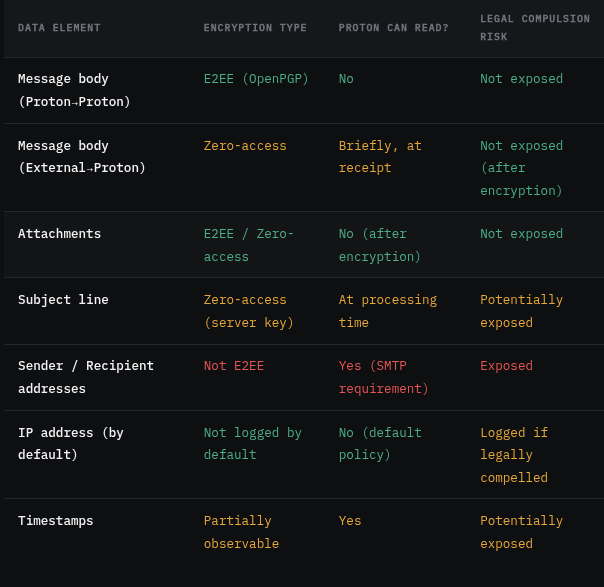
Message body encryption, however strong, leaves an entire class of sensitive information exposed: metadata. In the context of email, metadata includes the sender address, recipient address, subject line, timestamps, and IP addresses. These data points can be as revealing as message content — arguably more so in adversarial contexts, since metadata is structural and amenable to large-scale automated analysis.
We kill people based on metadata.
— Michael Hayden, former NSA Director, 2014
What Proton Encrypts (and How)
Proton Mail encrypts subject lines and stores them with zero-access encryption. This means the server encrypts the subject using the user’s public key after receipt, and only the user can decrypt it. However, this is not end-to-end encryption.
Here is the critical technical implication your intuition correctly identifies: zero-access encryption of metadata requires server-side access to the plaintext metadata at the moment of encryption. The server must read the subject line in order to encrypt it. If the subject were encrypted end-to-end by the sender’s client, Proton’s servers would hold opaque ciphertext for the subject — which would break server-side search entirely.
This means metadata encryption on Proton operates with a server-controlled key (or server-accessible mechanism), not the user’s private key. The user’s public key is used for body content; the metadata encryption necessarily involves server-side keying material that Proton controls. This is a logical necessity, not a hidden fact — but it is rarely stated explicitly in consumer-facing documentation.
Open Source: A Partial Truth
Proton’s open-source posture is frequently cited as a transparency guarantee. The reality requires precision.
Proton has released the source code for its web client, iOS app, Android app, and the Proton Bridge application. These clients have been independently audited by security firms including Securitum and Cure53. The cryptographic libraries Proton maintains for JavaScript and Go are also open source. This is meaningful: it allows independent verification that the client-side cryptography is correctly implemented and that private keys are not exfiltrated.
What remains closed. The backend server infrastructure — the code that handles SMTP ingestion, message routing, the zero-access encryption of incoming external mail, and metadata storage — is closed source. Proton has not published this code. The stated rationale includes anti-spam protection and competitive concerns. The consequence is that the most critical trust claims — that plaintext is discarded immediately after server-side encryption, that metadata access is minimized — cannot be independently verified through code inspection.
Proton mitigates this partially through third-party operational audits. In May 2024, Proton received ISO 27001 certification. In July 2025, Proton completed its first SOC 2 Type II attestation, which provides third-party validation that operational security controls are consistently applied in practice. These are meaningful compliance signals, particularly for enterprise users, but they are process audits — not code audits of the backend.
Jurisdiction: Switzerland as a Privacy Shield
Proton’s Swiss incorporation is a substantive technical and legal advantage. Switzerland is not a member of the EU and is outside the jurisdictions of US surveillance frameworks (including FISA, National Security Letters, and the Cloud Act). Swiss data protection law does not compel providers to implement backdoors.
However, the protection is not absolute. Proton complies with lawful Swiss court orders. Per Swiss criminal procedure, Proton can be legally compelled to log IP addresses in the context of a criminal investigation. Proton’s own documentation acknowledges this explicitly and recommends Tor or Proton VPN for users requiring IP anonymity.
A 2021 case established that Proton was required to provide user IP address data in response to a Swiss court order related to a French climate activist. This was consistent with Swiss law and Proton’s stated policy — but it illustrates that “Swiss jurisdiction” is not a blanket immunity from legal process. It is a significantly stronger protection than US or EU jurisdiction, but it is not zero-risk for users who are subjects of Swiss criminal investigations.
The Honest Tradeoff Map
Every architectural decision in Proton Mail reflects a deliberate tradeoff between security, usability, and SMTP interoperability. These tradeoffs are not hidden, but they are rarely presented together in one place.
What Proton genuinely solves. Against a passive adversary — a provider mining your email for advertising, a data broker purchasing bulk email data, or an attacker who compromises stored email databases — Proton’s zero-access encryption of stored messages is effective. Your inbox contents, once encrypted on Proton’s servers, are useless to anyone who breaches the database. This is a categorical improvement over Gmail.
What Proton partially solves. Against a legal adversary with Swiss jurisdiction, Proton can protect stored message content (cannot be decrypted even under compulsion) but cannot protect metadata. Subject lines, sender/recipient addresses, and — under legal order — IP addresses are accessible.
What Proton cannot solve. The SMTP constraint means that any email originating from a non-Proton provider (Gmail, Outlook, etc.) passes through Proton’s servers in plaintext before encryption. This is not a Proton failure — it is a protocol invariant. Additionally, the closed-source backend means that Proton’s handling of this plaintext window cannot be independently verified. For a truly adversarial threat model — state-level actors, insider threats at Proton, or legal compulsion of Proton’s backend operations — the trust assumption is non-trivial.
The Trustless Boundary
The term trustless has a precise meaning in cryptographic contexts: a system is trustless if its security guarantees hold without requiring trust in any party. Bitcoin achieves this for transactions through proof-of-work consensus. Signal achieves this for messaging through E2EE with open-source server code and sealed sender. Proton Mail achieves this only for Proton-to-Proton communication on the message body. Everything else involves some degree of trust — in Proton’s operational integrity, in Swiss legal process, in the closed-source backend doing what the documentation claims.
This is not a condemnation. Trust hierarchies exist in all systems. The question is whether the trust is well-placed and whether the attack surface matches your threat model. For the vast majority of users, Proton’s model is dramatically superior to unencrypted webmail. For journalists communicating with sources in authoritarian states, or activists facing state-level adversaries, the residual trust surface warrants additional operational security measures beyond Proton Mail alone.
Today take
Proton Mail is a well-engineered, thoughtfully designed service that pushes against the structural limits of SMTP as far as those limits allow. Its client-side cryptography is open source and independently audited. Its Swiss jurisdiction provides meaningful legal protection for stored content. Its zero-access encryption ensures that a database breach exposes only ciphertext.
But it is not trustless. The SMTP protocol guarantees that external mail arrives in plaintext. The closed-source backend means that plaintext handling cannot be verified. Metadata — subject lines, addresses, timestamps — carries weaker cryptographic protection than message bodies. And Swiss law, while strong, is not an absolute shield.
Understanding these boundaries is not a reason to avoid Proton Mail. It is a reason to use it with accurate expectations: as a significant improvement over conventional email, within a threat model that acknowledges its limits. For the highest-sensitivity communications, layering Proton with PGP key exchange, Tor, and careful metadata discipline remains the correct approach.
The protocol is the constraint. The architecture is the best available response to that constraint. The trust is yours to calibrate.
A possible solution is to install stalwart on a dedicated VPS hosted in Switzerland as you can achieve with denali.pro .
Sources used
RFC 821 (1982) — Simple Mail Transfer Protocol, Postel
RFC 5321 (2008) — Simple Mail Transfer Protocol, Klenlin / IETF
Proton Mail — How Proton Mail messages are encrypted (proton.me/support)
Proton Mail — Zero-access encryption (proton.me/blog/zero-access-encryption)
Proton Mail — What is encrypted within Proton Mail (proton.me/support)
Proton Mail — Open source at Proton (proton.me/community/open-source)
Proton Mail — SOC 2 Type II attestation (proton.me/blog/soc-2, July 2025)
Wikipedia — Proton Mail
Wikipedia — Simple Mail Transfer Protocol
Securitum — Proton Mail security audit report
grande e dettagliato articolo 👏
Io ne ho avuto la prova pratica personalmente che proton non è quello che vuol fare credere, poi ho saputo che il fondatore o uno dei fondatori di proton è proprio un personaggio politico nell’ambito europeo di quelli … “anti privacy”