


Every Bitcoin transaction is permanently recorded on a public ledger. Every UTXO you spend leaves a trace. Every address you reuse becomes a thread that chain analysis firms can pull. This is not a bug — it is how the protocol works, by design. But it does mean that if you care about financial privacy, you need to think carefully about how you move your coins.
The Lightning Network does not solve every privacy problem in Bitcoin. But used with intention, it offers tools that on-chain transactions simply cannot replicate. This article covers how to open Lightning channels with privacy in mind, how to use specific UTXOs for channel funding, how private (unannounced) channels work, and how the loop-out technique can effectively break the on-chain link between old and new UTXOs.
All examples use LND (Lightning Network Daemon) with lncli version 0.20.1 on mainnet.
What the Blockchain Actually Reveals
When you open a Lightning channel, a funding transaction is broadcast on-chain. This transaction creates a 2-of-2 multisig output — the channel itself. It is visible to everyone. The UTXO you used to fund the channel is publicly linked to the channel’s funding transaction. That link is permanent and irreversible on-chain.
This is why the choice of which UTXO you use to open a channel matters. If that UTXO is associated with your identity — because it came from a KYC exchange, or was received at an address you’ve publicly shared — then the channel open carries that identity forward.
Lightning transactions themselves do not appear on-chain. Payments are routed off-chain through channels, using onion routing to obscure the path from intermediate nodes. Common on-chain analysis heuristics — common-input-ownership, change address detection, amount-based clustering — fundamentally do not apply to Lightning payments because there are no on-chain inputs or outputs for each individual payment. The channel balance is known only to the two parties sharing it.
But “better than on-chain” is not the same as “private.” Let’s look at where the real risks and real opportunities lie.
Public Channels vs. Private (Unannounced) Channels
By default, when you open a Lightning channel, you announce it to the network. Your node ID, your peer’s node ID, the channel capacity, and the funding UTXO all become part of the public channel graph — discoverable by anyone querying the network.
For routing nodes, this is necessary. Announcing a channel allows other nodes to route payments through you, which earns fees. But if you are not running a routing node — if you just want to send and receive payments privately — announcing your channels is an unnecessary exposure.
LND offers a --private flag precisely for this purpose. A private channel (also called an unannounced channel) is not broadcast to the network graph. Your peer knows about it, and you can still route payments through it using route hints, but no third party can discover its existence by querying the graph.
Opening a Standard (Announced) Channel
in this example we open to the Loop node, using a specified UTXO in the onchain wallet.
lncli openchannel \
  --node_key 021c97a90a411ff2b10dc2a8e32de2f29d2fa49d41bfbb52bd416e460db0747d0d \
  --connect 50.112.125.89:9735 \
  --utxo XXX:0 \
  --fundmax \
  --sat_per_vbyte 5
This opens a channel that will be announced to the network. The channel will appear in graph queries. Anyone can see your node’s connection to this peer.
Opening a Private (Unannounced) Channel
lncli openchannel \
  --node_key 021c97a90a411ff2b10dc2a8e32de2f29d2fa49d41bfbb52bd416e460db0747d0d \
  --connect 50.112.125.89:9735 \
  --utxo XXX:0 \
  --fundmax \
  --private \
  --sat_per_vbyte 5
The --private flag tells LND not to announce this channel. The funding transaction still appears on-chain — you cannot avoid that — but the association between your node and this peer is not broadcast to the graph.
Important nuance: the funding transaction is still publicly visible. A sufficiently motivated chain analyst who knows your node’s on-chain wallet addresses can still identify the funding output as a 2-of-2 multisig and flag it as a likely Lightning channel. What they lose is the graph-level confirmation of who your peer is and that this channel exists as an active route. This is a meaningful improvement, not a complete solution.
Coin Control: Choosing Which UTXO Funds the Channel
One of the most significant privacy tools available in modern LND is explicit UTXO selection for channel opens. This was introduced in LND v0.17.0 and is available in all subsequent versions including 0.20.1.
The --utxo flag lets you specify exactly which UTXO the funding transaction will consume. Combined with --fundmax, it ensures the entire UTXO is consumed — no change output is created.
lncli openchannel \
  --node_key <PEER_PUBKEY> \
  --utxo <txid>:<vout> \
  --fundmax \
  --sat_per_vbyte 5
Why does this matter? Two reasons:
No change output. When LND’s wallet automatically selects coins for a channel open, it may combine multiple UTXOs or create a change output. Change outputs are a classic privacy leak — chain analysis heuristics use them to cluster UTXOs and infer wallet ownership. Using --utxo with --fundmax eliminates this by spending the entire selected UTXO into the channel, leaving no residue.
Deliberate UTXO segregation. If you have UTXOs of different origin — some from a KYC exchange, some mined, some received peer-to-peer — you want full control over which history gets attached to a channel open. Letting the wallet pick automatically risks merging inputs from different sources, which is one of the strongest signals chain analysis can find.
To list your available UTXOs before opening a channel:
lncli listunspentThis will show you each UTXO, its txid:vout reference, amount, and confirmation status.
The Loop-Out Technique: Breaking the UTXO Trail
This is where Lightning becomes genuinely useful for privacy beyond just “not broadcasting transactions.” The loop-out technique allows you to effectively sever the on-chain link between an old UTXO and a new one — without CoinJoin, without a centralized mixer, and without closing your channel.
The mechanism is a submarine swap — a trustless atomic exchange between an off-chain Lightning payment and an on-chain Bitcoin output. The key property is that the swap is non-custodial: the counterparty cannot steal your funds because the on-chain payment is conditional on the completion of the off-chain payment, enforced by hash time-locked contracts (HTLCs). As Mastering the Lightning Network explains, submarine swaps allow the exchange of on-chain bitcoin for Lightning payments and vice versa, atomically and without requiring trust in the counterparty.
The privacy flow looks like this:
UTXO you want to dissociate from → channel funding tx → off-chain LN payment → submarine swap → clean UTXO at fresh addressStep by step:
Open a channel using the whole UTXO you want to disassociate from. Preferably an unannounced channel.
Execute a loop-out: send a Lightning payment through the channel and receive the equivalent amount on-chain at a brand-new address that has never appeared on the blockchain before.
Result: the original UTXO is now “inside” the channel’s funding transaction. The blockchain sees the funding tx, then sees a new on-chain output at an unrelated address. The connection between the two is not visible on-chain.
The channel closing transaction will eventually appear on-chain if you close, but by that point the funds have already exited through the loop-out. The chain sees disconnected events, not a direct transfer.
Example opening
we open a private channel to Aciq:
dev@lnbits00:~$ lncli openchannel --node_key 03864ef025fde8fb587d989186ce6a4a186895ee44a926bfc370e2c366597a3f8f \
--connect 34.239.230.56:9735 \
--utxo edd21f89192aa98592d08323320c6d19d7c92e395664ccXXXX:0 \
--fundmax \
--private \
--sat_per_vbyte 2
{
    "funding_txid": "fab3afc09824bbc7ef22f31727ec390190cfbXXX"
}
result
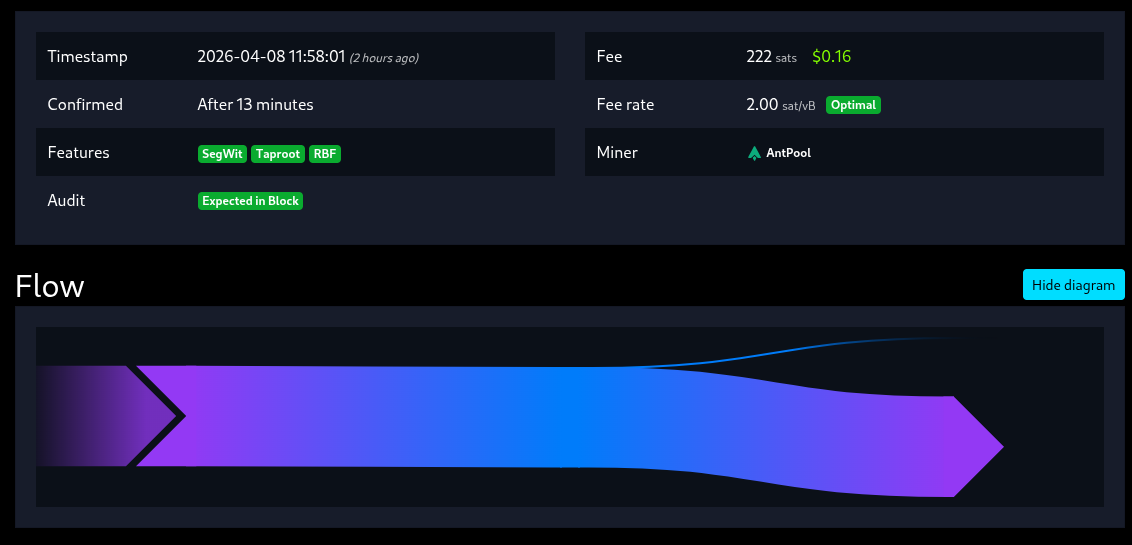
here the correct channel setup ready to manage with loop out

as you can see onchain, this channel opening has not generated a change output, exactly as we needed for the purpose of this experiment

Using Loop (Lightning Labs)
Loop is the official submarine swap tool from Lightning Labs, the team behind LND. It requires a running LND node:
loop out --amt <satoshis> --addr <new_onchain_address>Replace <satoshis> with the amount you want to swap out (must be within your channel’s local balance), and <new_onchain_address> with a fresh address generated from a wallet that has no prior transaction history — ideally a hardware wallet address you have never used.
You can monitor progress with:
loop monitorLoop charges a small fee for the service, which includes both routing fees for the off-chain leg and on-chain fees for the sweep.
Using Boltz (Non-Custodial Alternative)
If you prefer not to use a Lightning Labs service, Boltz offers the same submarine swap functionality and is widely used in the Bitcoin privacy community. The conceptual flow is identical:
you → (private channel) → peer → ... → Boltz → fresh UTXO on-chainBoltz also operates non-custodially using the same HTLC mechanism. You initiate the swap from their interface or API, pay the Lightning invoice through your node, and receive on-chain funds at the address you specify. No account, no KYC.
What This Does Not Protect You From
Privacy techniques are only useful if you understand their actual scope. Here is what the above methods do not protect you from:
The funding transaction is always public. Whether your channel is announced or private, the on-chain funding transaction exists. A chain analyst can see a 2-of-2 multisig output being created. Post-Taproot, cooperative channel closes look like regular single-sig transactions, which improves this picture — but unilateral closes still reveal HTLC scripts, which are identifiable.
Your peer knows everything about the channel. In a private channel, your direct peer knows the channel exists, knows the funding UTXO, and observes every payment going through it. If your peer is a large, well-connected routing node run by a company, you are trusting them with significant information.
A node with only one channel has no anonymity set. If your node has a single channel to a single peer, that peer can observe all your payments regardless of onion routing. As documented in the Bitcoin Wiki Privacy page, when a Lightning node wallet has only a single channel connection, the intermediate node can obtain a lot of information about payments regardless of the onion-routing used. Multiple channels to diverse peers expand your anonymity set.
Loop-out is not full unlinkability. Blockchain analysis firms like Chainalysis are aware of the patterns created by Lightning channel opens and loop-outs. The “Star” and “Collector” heuristics can identify likely channel funding transactions and cluster activity around Lightning nodes. The loop-out disrupts the direct UTXO link, but if your node’s on-chain wallet is already associated with your identity, the channel open itself carries that forward.
Run your node over Tor. Without Tor, your node’s IP address is publicly associated with your node ID. This is an orthogonal leak but a significant one.

Just a small recap
Lightning channels are not a privacy silver bullet, but they are a meaningful tool when used correctly. The combination of:
Explicit UTXO selection (
--utxo+--fundmax) to control which coin history enters a channel,Private channels (
--private) to keep your peer relationships off the public graph,Loop-out via Loop or Boltz to exit the Lightning layer at a fresh on-chain address,
Running over Tor to prevent IP-to-identity correlation,
...represents a practical, non-custodial privacy stack available to anyone running LND today.
It requires deliberate effort. It is not zero-risk. But it is real, it works, and it does not require trusting a third party with your funds.
If you want to go deeper on Lightning node setup, privacy practices, or hosting your own node on a security enhanced VPS with Tor pre-configured, check out denali.pro — we run production Lightning infrastructure and can help you get it right from the start.
nice one Massimo