


Today my proposal is to discuss about a possible way to enhance privacy of your UTXOs through a technique involving Lightning Network. While Coinjoin remains without any doubt the most effective way to increase privacy if the anonset is enough, it’s good to test additional methods with different trade offs and results and analyze them. Here is one.
Description
Let's say I have a bitcoin UTXO in a wallet. I want to increase the privacy of this UTXO but without using coinjoin. This is the plan of this setup.
- Open a Phoenix wallet using Tor on a phone. it is installed from scratch and first connected with tor;
- Spend the entire UTXO (you have on a wallet where you own the keys) to a Phoenix onchain address (as provided by the new installed wallet). Phoenix will automatically open a channel to handle this operation;
- Once the channel is open (a channel to acinq), create 2 or more swaps on Boltz from Lightning (on phoenix) to On-chain and pay for them using Phoenix, resulting in the transaction being sent to another of unused onchain addresses you own, through the Boltz service. These swaps need to be executed from tor and without any timing and amount relationship correlations with the original UTXO.
The initial amount of the UTXO will be recovered into 2 or more swap operations on 2 or more on-chain destinations without correlation of time and amount.
Let’s analyze what we have
What you are doing:
You are effectively breaking the chain of direct on-chain transactions;
Using the Lightning Network as an intermediary creates an obfuscation by going on the layer 2 on the blockchain;
Boltz swap adds an additional layer of separation;
Using Tor with Phoenix helps protect privacy at the network level;
Issues and limitations:
Opening a Phoenix channel: When you send funds on-chain to Phoenix, the channel opening transaction is visible on the blockchain and directly links your initial UTXO to the Lightning channel address. This link is public and traceable. This channel will be open from the acinq LSP.
Temporal analysis: If transactions occur in quick succession (send to Phoenix → Boltz swap), temporal analysis could correlate the transactions, especially if the amounts are similar or identical. For this reason is strongly important to care this aspect.
Amounts: If the final amount is very close to the initial amount (minus fees), this can be an indicator of correlation. For this reason it is strongly important to break the initial amount to different LN/On-chain swaps in different time frames.
Phoenix as a centralized point: Acinq can theoretically see both the channel opening and the Lightning payments you make, so they could correlate the transactions. This is a point you have to consider. there is no trustless privacy in this part.
Boltz: Boltz, as a swap service, also sees the correlation between the incoming Lightning payment and the outgoing on-chain UTXO.
So what?
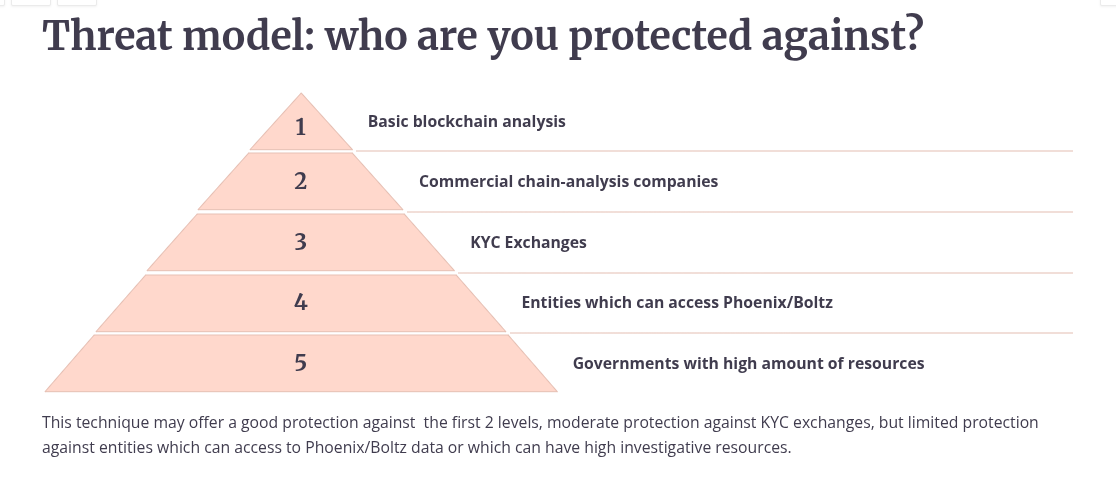
For an external observer of the blockchain who does not have access to Phoenix or Boltz data, the final funds have no direct on-chain link to the initial UTXO.
But there are tradeoffs. Privacy is not absolute (when ever it could be) because:
The initial transaction to Phoenix is public
You must trust that Phoenix and Boltz do not share/correlate data
Time and amount analysis may suggest links, so you must be careful about time and amounts

Variations
We can do more effective variations to enhance the results. For example using on- demand lightning nodes (like nimblenode for example). Or using another layer on liquid swaps. We will go inside these techniques in the next articles and video contents. Stay tuned.
What about persistence of the layer 2 components (LN, Boltz, LSP etc.)? Can we assume that - even if they record sensible data such as IP or similar - such data will never be as persistent as OC information? In other words: if a not expert user swap through LN but does not care of net privacy (e.g. no TOR), can he/she assume that after a long time (years) all routing data will be lost?